CASE STUDY
Designed one of the most comprehensive business banking platforms in India, exclusively for corporate banking clients

Kotak FYN
The work involved bringing clarity to data-heavy banking experiences while operating within fixed legacy systems and established banking flows. The platform needed to support both awareness and action in the same experience, serving multiple user roles through a single interface. At the same time, the focus was on setting a scalable foundation by thinking beyond individual screens and designing systems that could grow. This was achieved by leveraging the bank’s existing design system and thoughtfully adapting it to meet the product’s specific requirements.
Industries
Banking and Finance B2B enterprise platform
Services we offered
-
System design
-
Centralized design system
-
UX UI Design
Challenges
The challenge was to bring clarity to data-heavy banking experiences, work within fixed legacy systems, support awareness and action in the same flow, serve multiple roles through one platform, and design a scalable system while making confident decisions under pressure.
What is FYN?
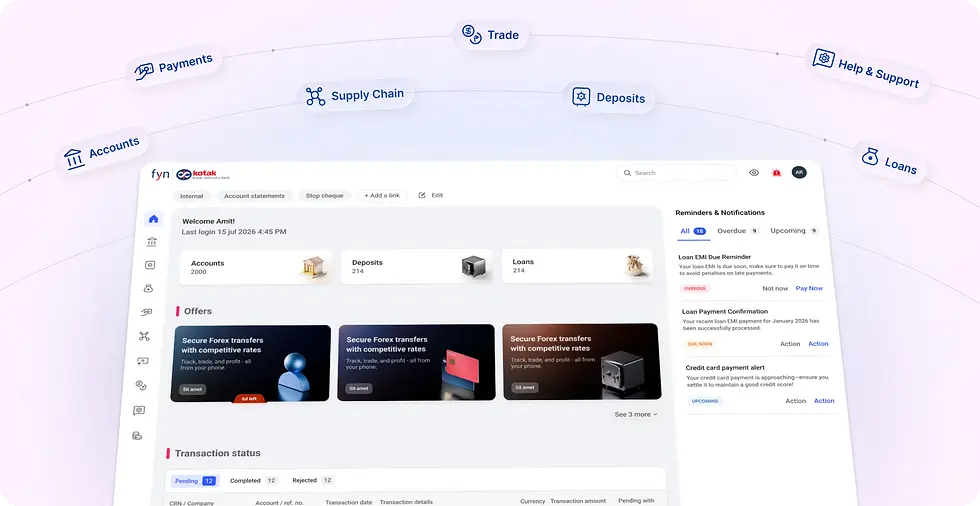
A digital platform for corporate customers to view, manage, and act on their business finances in one place. A corporate customer is a business that manages money across multiple accounts, users, and approvals, unlike a retail customer who banks as a single individual for personal needs.
Who Uses FYN?
FYN serves multiple user roles, each with distinct responsibilities and expectations. Understanding these personas was critical to designing clear, role-aware, and scalable experiences across the platform.

The dashboard
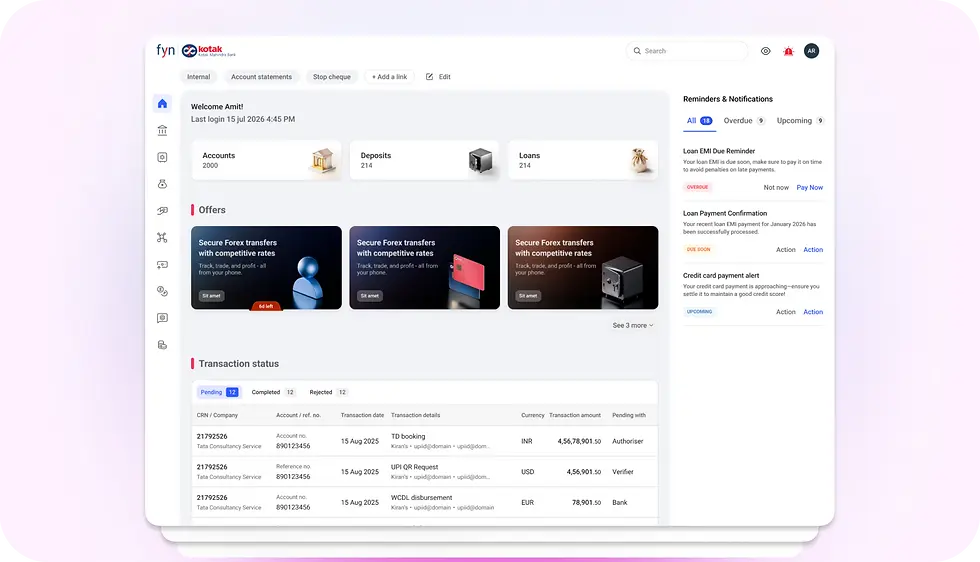
The dashboard was designed as a true overview of the platform, surfacing priority actions, quick access to accounts, deposits, and loans, along with relevant offers such as loans and cards. A reminders and notifications sidebar enabled fast visibility into actionables and important information, while a bookmark-style quick links feature allowed users to save frequently accessed pages, including deep-level screens, reducing repeated navigation. The navigation sidebar was intentionally kept thin to maximise space for core modules and maintain focus on efficiency and clarity.
Fund transfer for corporate
The existing fund transfer module, E-Transfer, was built on a third-party legacy system, while Paylite was designed fresh, allowing us to define the experience end to end with compliance as the primary constraint rather than legacy UX limitations. The objective was to enable users to execute multiple transactions efficiently, eliminate unnecessary back-and-forth between screens, and optimise the experience for corporate users who perform high-frequency transactions daily.
A Unified Experience
It was designed around a single, information-rich structure that allowed users to initiate and manage fund transfers without moving through fragmented, step-based flows. Whether transferring to third-party accounts, scheduling recurring payments, or moving funds between own accounts, the experience kept all critical context and actions in one place, optimised for speed and high-frequency usage.


Beneficiary management
at Scale
Unlike retail banking, beneficiary management in the corporate context supported grouped beneficiaries, where a single payee could have multiple linked accounts. This added complexity to the flow, requiring clear structure and visibility to ensure users could manage, select, and transact with the right account quickly and confidently.

Scalable Service Request Framework
With over 200 to 300 service requests on the platform, designing each one individually was not scalable. We introduced a templatised service request framework with shared layouts and rules, enabling product and engineering teams to create and manage new requests independently, while maintaining consistency and efficiency across the platform.

Setting the Design Foundations
We leveraged Kotak’s existing design system while rebuilding key components to support complex, data-heavy use cases. To ease development and maintenance, we created a wrapper around the existing design system, allowing teams to extend functionality while preserving the core system and brand consistency.


